Showing posts with label examination tips. Show all posts

Wednesday, 7 November 2012

How to draw Economics diagrams

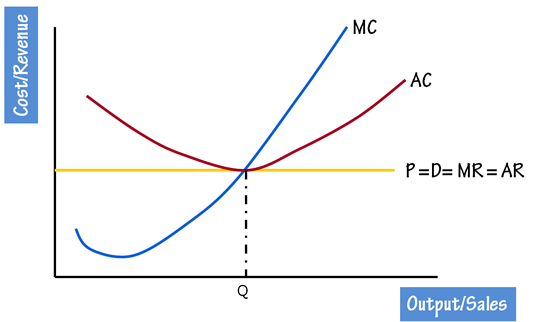
Drawing Cost/Revenue curves and Market structure curves is usually a confusing affair for students. Just follow these 4 steps and you will never go wrong with your diagrams. There is a detailed PowerPoint presentation on dineshbakshi.com which illustrates all these steps. Click here to goto to the Presentation page

Step 1

Draw a Revenue Curve i.e. MR & AR curves

Step 2

Now place revenue curves i.e. AC and MC curves.
  • If there is abnormal profit the AC curve will be below the AR curve.
  • If there is loss then the AC curve will be above the AR curve.
  • If the firm is having normal profit then the AC curve touches the AR curve.

Step 3

Now, identify the output level of the firm. It is always be the profit maximisation level, i.e. the point where the MC cuts the MR.

Step 4

At the profit maximisation level, identify the cost on AC curve and the revenue at AR curve. The difference will give to abnormal profit and loss accordingly.

Congratulations!! You have completed the diagram.


Saturday, 19 May 2012

Getting a 7 in IB Economics - Post 1

Dear students,
In this series of 'Getting a 7 in IB Economics' I would be giving you useful tips on how to improve your grades in IB Economics. In this particular post I am going to state 5 things which are a must when it comes to writing an excellent extended response question.

5 Commandments for getting good grades in IB Economics


  1. Always define terms accurately: Whenever you use a economic term, define it accurately. When I say ' accurately', I mean  you have to use the key terms which make a definition complete. For example, Inflation is a persistent rise in the average price level of goods and services over a period of time. Here, the key words are 'persistent', 'over a period of time'. Without these key words the definition might be considered as vague and you will end up getting only half the marks.
  2. Use diagrams effectively: IB Examiners love diagrams. Use appropriate diagrams to explain your answers/concepts. Students are expected, where appropriate, to include correctly labelled and clearly drawn diagrams.Drawing a diagram is not enough, it has to be explained also. For example, while explaining demand pull inflation on an AD/AS diagram the student can write.... 'The increase in AD from AD1 to AD2 will lead to a increase in real output from Y1 to Y2, however it will also lead to a rise in general price level from PL1 to PL2. 
  3. Structure your answer: An extended response questions should have a logical structure. The arguments and discussion should have logical flow. A good answer will have relevant concepts developed in reasonable depth, demonstrate effective evaluation, supported by appropriate evidence or theory.
  4. Application : Students are expected, where appropriate, to illustrate their answers with examples in order to reach the highest markbands. Always use real life examples to strengthen your answer. In case you are doing a data response question then refer to the text and make effective use of data presented. 
  5. Evaluation is very important: Effective evaluation consists of  considering the short run versus long run consequences of a phenomenon/decision on on different stakeholders. Discussion of its advantages and disadvantages.

 Coming next... Attempting Paper 1

Wednesday, 10 August 2011

Answering part d in IB Economics Paper 3 (HL)


What makes the difference?


On very short responses (a half page or less) it is difficult to get above level 1 purely because insufficient points can be explained and there is little possibility of applying theory sufficiently to explain a point to L2 .

Mostly candidates manage to analyse (ie explain a point by applying theory) but are not able to evaluate (i.e. giving an informed judgement based on or linked to material in the text L3). Candidate's often restate material in the text that can appear as though they are answering the question; however, unless they are applying economic theory to explain their answer then often all that they are doing is restating the text.

Often candidate's will also state an answer rather than develop an answer. For example "The government stimulus package will fix the recession". While this may be true, it is stated rather than developed by applying theory. A good response would say something like "the government's stimulus package of X billion euro will stimulate household consumption and possibly investment if it is also targeted at firms. An increase in consumption and investment will result in an increase in AD and thus increase GDP Blah blah blah ..... This is an example of L2 where the candidate is analysing or evaluating economic theory.

To go the next level the candidate needs to continue on saying things like "the problem with stimulating the economy with the X billion euro stimulus package is that the government is likely to incur a budget deficit. Persistent budget deficits lead to increasing indebtedness and if sustained can undermine international confidence in both the government and the economy and their capacity to repay the debt". This can lead to ....".