Showing posts with label ib economics. Show all posts

Wednesday, 7 November 2012

How to draw Economics diagrams

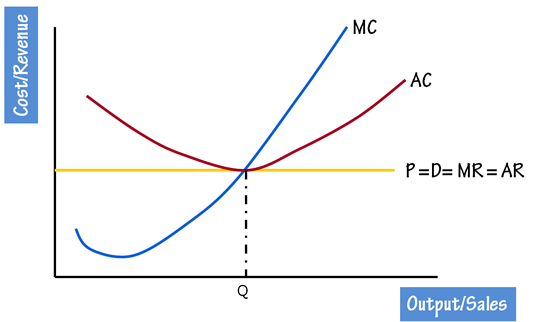
Drawing Cost/Revenue curves and Market structure curves is usually a confusing affair for students. Just follow these 4 steps and you will never go wrong with your diagrams. There is a detailed PowerPoint presentation on dineshbakshi.com which illustrates all these steps. Click here to goto to the Presentation page

Step 1

Draw a Revenue Curve i.e. MR & AR curves

Step 2

Now place revenue curves i.e. AC and MC curves.
  • If there is abnormal profit the AC curve will be below the AR curve.
  • If there is loss then the AC curve will be above the AR curve.
  • If the firm is having normal profit then the AC curve touches the AR curve.

Step 3

Now, identify the output level of the firm. It is always be the profit maximisation level, i.e. the point where the MC cuts the MR.

Step 4

At the profit maximisation level, identify the cost on AC curve and the revenue at AR curve. The difference will give to abnormal profit and loss accordingly.

Congratulations!! You have completed the diagram.


Saturday, 19 May 2012

Getting a 7 in IB Economics - Post 1

Dear students,
In this series of 'Getting a 7 in IB Economics' I would be giving you useful tips on how to improve your grades in IB Economics. In this particular post I am going to state 5 things which are a must when it comes to writing an excellent extended response question.

5 Commandments for getting good grades in IB Economics


  1. Always define terms accurately: Whenever you use a economic term, define it accurately. When I say ' accurately', I mean  you have to use the key terms which make a definition complete. For example, Inflation is a persistent rise in the average price level of goods and services over a period of time. Here, the key words are 'persistent', 'over a period of time'. Without these key words the definition might be considered as vague and you will end up getting only half the marks.
  2. Use diagrams effectively: IB Examiners love diagrams. Use appropriate diagrams to explain your answers/concepts. Students are expected, where appropriate, to include correctly labelled and clearly drawn diagrams.Drawing a diagram is not enough, it has to be explained also. For example, while explaining demand pull inflation on an AD/AS diagram the student can write.... 'The increase in AD from AD1 to AD2 will lead to a increase in real output from Y1 to Y2, however it will also lead to a rise in general price level from PL1 to PL2
  3. Structure your answer: An extended response questions should have a logical structure. The arguments and discussion should have logical flow. A good answer will have relevant concepts developed in reasonable depth, demonstrate effective evaluation, supported by appropriate evidence or theory.
  4. Application : Students are expected, where appropriate, to illustrate their answers with examples in order to reach the highest markbands. Always use real life examples to strengthen your answer. In case you are doing a data response question then refer to the text and make effective use of data presented. 
  5. Evaluation is very important: Effective evaluation consists of  considering the short run versus long run consequences of a phenomenon/decision on on different stakeholders. Discussion of its advantages and disadvantages.

 Coming next... Attempting Paper 1

Thursday, 4 August 2011

What is Evaluation?


As we all know evaluation skills are high order thinking skills and play a vital role in making a grade difference. While writing commentaries or attemtping extended response questions or answering data response questions, proper evaluation done will decide whether a student will fall in the top level category or not. Here is a brief expalantion of what is actually expected from a student
Evaluation occurs when a judgment is made. It is the weighing or measuring of factors followed by an attempt to give relative weight to those factors. Questions that begin “evaluate”, “assess”,“critically assess”, “discuss” or “to what extent” require candidates to show their skills of evaluation in order to reach the highest achievement levels.
Invites candidates to make an appraisal of a situation. Candidates should weigh the nature of the evidence available and discuss the convincing aspects of an argument as well as its implications and limitations, and the less convincing elements within an argument. For example:
Evaluate alternative policies designed to reduce inflation.
There are many ways that candidates can be encouraged to improve their skills of evaluation.
  • What factors such as causes, consequences or remedies are asked for, candidates should attempt to identify the most important ones and then to justify the reason for the choice.
  • When advantages and disadvantages are asked for, candidates should attempt to identify the most important advantage (or disadvantage) and then justify the reason for the choice.
  • When strategies are asked for, candidates should attempt to assess the short term and long term implications.
  • When data is offered, candidates may question its validity, in terms of whether it is appropriate, whether it is reliable, or whether it is still relevant.
  • When summarizing a theory, candidates may question its validity, in terms of whether it is appropriate, whether it is reliable, or whether it is still relevant.
I hope this post helps!!

Wednesday, 6 July 2011

Mind Maps for IB Economics


dineshbakshi.com has come up with a new collection of IB Economics Mind Maps. These Mind Maps are based on different topics and integrate all important points from the topic and provide a wonderful tool for last minute revision for students.
The latest addition to this collection are the following Mind Maps.
Aggregate Supply

Aggregate Demand

Perfect Competition

Oligopoly

Monopolistic Competition

Sunday, 19 June 2011

IB Economics resource list


Textbooks
  1. IB Diploma Course Companion: Economics Second Edition: Jocelyn Blink and Author Ian Dorton ISBN: 978-0-19-918499-6 Publication Date: April 2011 (estimated) OUP
  2. Economics from a Global Perspective: Alan Glanville ISBN: 0952474654 Glanville books
  3. Economics in terms of the Good, the Bad and the Economist: Mattt McGheeISBN: 978-1-876659-22-6 IBID press
  4. Economics for the IB Diploma: Ellie Tragakes, ISBN-10: 0521744342 ISBN-13: 978-0521744348 Cambridge University Press

Supplementary books
  1. Banker to the poor: the story of the Grameen bank: M. Yunus ISBN: 0143102915
  2. The end of poverty: J. Sachs ISBN 0141018666
  3. Studies in Economics and Business: Markets and Market Failure: ISBN 9780435330507 Heinemann
  4. Studies in Economics and Business: Supply Side Policies: ISBN 9780435330477 Heinemann
  5. Studies in Economics and Business: Development Economics: ISBN 9780435330484 Heinemann
  6. AP Economics,(answers)John S Morton 3rd edition ISBN1-56183-568-4 Activities, worksheets, quantitative(American curriculum ,be selective, consists of student worksheet)
  7. Economics-John Sloman ISBN978-0273655749 (teacher ref)
  8. Economics student workbook -John Sloman ISBN 978-0273705178 (quantitative exercises)
  9. Everlasting light bulbs: how economics illuminates the world JHN ISBN 978-0954809300 (quick illustrations of economic concepts)
  10. Undercover Economist Oxford University Press ISBN13-978-0195189773
Revision guides
  1. Economics HL Approach your exams the IB way: Blink and Dorton ISBN 9781906345129
  2. Economics SL Approach your exams the IB way: Blink and Dorton ISBN 9781906345136
  3. IB Study Guide: Economics for the IB Diploma: C Ziogas ISBN: 9780199152285


Online resources
  1. www.dineshbakshi.com huge collection of revision notes, interactive quizzes and other resources for teachers and students
  2. http://www.peteranthony.org/
  3. http://vimeo.com/16626088? Site with lots of very short videos, including form the world bank (international and development)
  4. https://www.nytimes.com/interactive/2010/11/13/weekinreview/deficits-graphic.html Interactive you “fix the budget activity” (macro)
  5. http://www.econtalk.org/archives.html 1 hour podcasts
  6. http://econblog.aplia.com/ News for Economics students with questions
  7. http://www.npr.org/rss/podcast/podcast_detail.php?siteId=94411890 US national public radio podcasts for Planet Money
  8. http://welkerswikinomics.wetpaint.com/ Jason Welker’s student wiki on the IB Economics course
  9. http://www.cosmolearning.com/economics/videos/ Online economics videos
  10. http://data.worldbank.org/ Data bank of economic and development indicators
  11. http://www.gapminder.org/world/#;example=75; Data site: graphing and videos
  12. http://www.youtube.com/profile?user=EconStories#grid/uploads Fun but informative rap songs about economics!
  13. http://www.bized.co.uk/learn/economics/index.htm Learning material for IB Economics
  14. http://www.ecb.int/ecb/educational/html/index.en.html European Central Bank: Info on monetary policy, short videos plus the Economia interactive game.
  15. Online Tools
  16. http://groups.diigo.com/group/econ-teachersOnline bookmarking group that posts articles relate to Economics
  17. www.Diigo.com You can set up your own groups of bookmarked articles
  18. www.Mindmeister.com Online collaborative mind maps (paying)
  19. http://docs.google.com Allows sharing of, and collaboration on, documents and PowerPoints.
  20. http://www.netvibes.com/ Personalized home pages that collate your RSS feeds from new sites
  21. http://www.aplia.com/
Teacher resource packs
  1. AS/A2 International Economics Teacher Resource Pack: B Ellis ISBN: 9780860033608 Hodder Education
  2. Friday Afternoon Economics A-Level Resource Pack + CD Author: Ruth Tarrant ISBN: 9780340966624 Hodder Education
Magazine
Economics Review (quarterly for 16-18 year olds): http://www.philipallan.co.uk/economicreview/index.htm

Assessment Outline for New IB Economics syllabus


Hi everyone,

IB Economics syllabus is changing and will be effective for students appearing for Examinations in year 2013 and after. But if you have your examinations before 2013 then this post is not for you.

We will just take an a broad overview of the assessement for the new syllabus.

Economics SL

External assessment (3 hours) 80%

Paper 1 (1 hour and 30 minutes) 40%
An extended response paper (50 marks)
Assessment objectives 1, 2, 3, 4
Section A
Syllabus content: section 1—microeconomics
Students answer one question from a choice of two. (25 marks)
Section B
Syllabus content: section 2—macroeconomics
Students answer one question from a choice of two. (25 marks)

Paper 2 (1 hour and 30 minutes) 40%
A data response paper (40 marks)
Assessment objectives 1, 2, 3, 4
Section A
Syllabus content: section 3—international economics
Students answer one question from a choice of two. (20 marks)
Section B
Syllabus content: section 4—development economics
Students answer one question from a choice of two. (20 marks)

Internal assessment (20 teaching hours) 20%
This component is internally assessed by the teacher and externally moderated by the IB at the end of the course.Bold
Students produce a portfolio of three commentaries, based on different sections of the syllabus and on published extracts from the news media.
Maximum 750 words x 3 (45 marks)

Economics HL

External assessment (4 hours) 80%

Paper 1 (1 hour and 30 minutes) 30%
An extended response paper (50 marks)
Assessment objectives 1, 2, 3, 4
Section A
Syllabus content: section 1—microeconomics
Students answer one question from a choice of two. (25 marks)
Section B
Syllabus content: section 2—macroeconomics
Students answer one question from a choice of two. (25 marks)

Paper 2 (1 hour and 30 minutes) 30%
A data response paper (40 marks)
Assessment objectives 1, 2, 3, 4
Section A
Syllabus content: section 3—international economics
Students answer one question from a choice of two. (20 marks)
Section B
Syllabus content: section 4—development economics
Students answer one question from a choice of two. (20 marks)

Paper 3 (1 hour) 20%
HL extension paper (50 marks)
Assessment objectives 1, 2 and 4
Syllabus content, including HL extension material: sections 1 to 4—microeconomics,
macroeconomics, international economics, development economics
Students answer two questions from a choice of three. (25 marks per question)

Internal assessment (20 teaching hours) 20%
This component is internally assessed by the teacher and externally moderated by the IB at the end of the course.Bold
Students produce a portfolio of three commentaries, based on different sections of the syllabus and on published extracts from the news media.
Maximum 750 words x 3 (45 marks)

source: IB Economics Guide 2013 copyright ibo.org

Next post will carry a detailed overview of the External Assessement details for IB Economics HL and SL. So keep in touch

Monday, 16 May 2011

Welcome to IB Economics

This blog is specifically written for students and teachers who are involved with IB Economics. It contains links to revision notes and other resources which will help IB Economics students to improve their grade. This blog also contains resources such as Powerpoint Presentations, Mind Maps, Worksheets, Internal Assessment and Extended Essay guidance for both teachers and students.
I am sure you all will gain a lot from this blog.
Moreover I would like to inform you that dineshbakshi.com is coming up with an all new section for IB Economics which will contain high quality resources absolutely free of cost. Visit http://www.ibeconomics.dineshbakshi.com
We would recommend you to please subscribe to this blog so that you are updated with the latest resources appearing on this blog.

So sit back and keep in touch!!

regards,
Dinesh Bakshi